
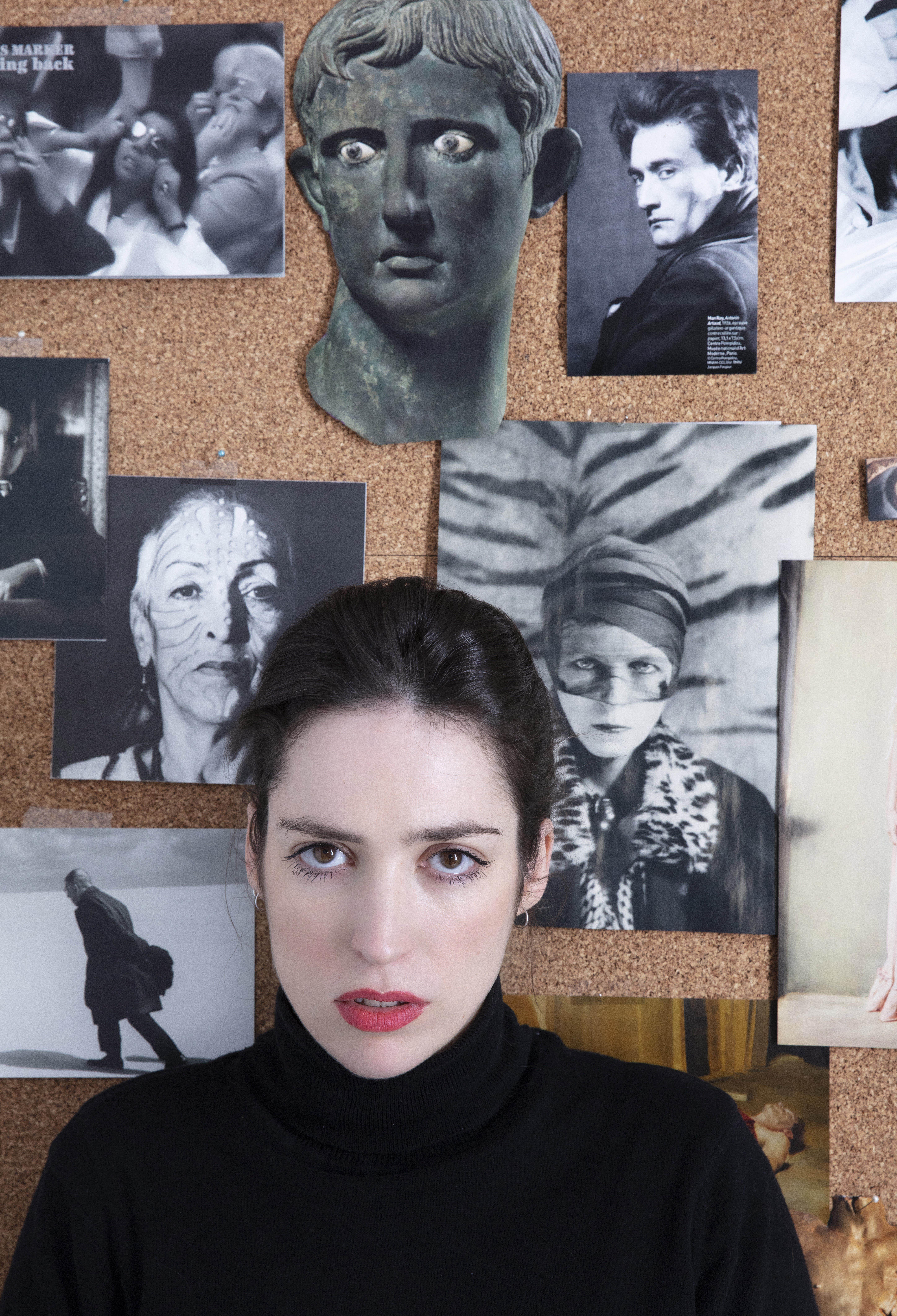
Née en 1982. Vit et travaille à Paris et en Sologne.
Born in 1982. Lives and works in Paris and Sologne.La pratique d’Émilie Girault se développe à partir d’une approche instinctive de la création, envisagée comme un mode de recherche à part entière. Sans médium privilégié, elle construit des projets qui prennent la forme de performances, d’installations, de vidéos, de photographies, de sculptures ou de peinutres, chaque forme étant choisie en fonction des enjeux du projet.
Depuis plusieurs années, l’ensemble de son travail s’inscrit dans la construction d’un univers fictionnel global intitulé Cet Autre Monde. Conçu comme une cartographie en constante évolution, cet ensemble permet de relier des œuvres a priori hétérogènes au sein d’un même territoire narratif et symbolique. Les projets y apparaissent comme des fragments, des zones ou des passages, laissant volontairement des espaces ouverts à de futures explorations.
La fiction joue ici un rôle structurant. Elle n’est pas pensée comme un récit clos, mais comme un outil de déplacement du regard, permettant d’aborder des problématiques contemporaines, telles que l’épuisement, l’isolement ou les transformations du vivant, sans recourir à une narration illustrative ou démonstrative. Les œuvres agissent comme des indices, des vestiges ou des situations, invitant le spectateur à construire sa propre lecture.
La performance occupe une place centrale dans cette recherche. Le corps y est engagé comme un espace d’expérimentation et de tension, traversé par des notions de rituel, d’enfermement, de résistance ou de lâcher-prise. Ces actions dialoguent avec les autres formes plastiques au sein d’un même système, sans hiérarchie de médium.
Ainsi, le travail d’Émilie Girault se déploie comme un monde en mutation, à la frontière entre fiction et réalité, où l’imaginaire devient un moyen d’interroger les récits collectifs contemporains et leurs possibles devenirs.
Émilie Girault’s practice develops from an instinctive approach to creation, understood as a mode of research in its own right. Without privileging any single medium, she constructs projects that take the form of performances, installations, videos, photographs, sculptures or paintings, each form being chosen according to the specific stakes of the project.
For several years now, her entire body of work has been part of the construction of a global fictional universe entitled This Other World. Conceived as a constantly evolving cartography, this ensemble makes it possible to connect works that may at first appear heterogeneous within a single narrative and symbolic territory. The projects appear there as fragments, zones, or passages, deliberately leaving open spaces for future explorations.
Fiction plays a structuring role here. It is not conceived as a closed narrative, but as a tool for shifting perspective, allowing contemporary issues, such as exhaustion, isolation, or transformations of the living, to be addressed without resorting to illustrative or demonstrative storytelling. The works function as clues, vestiges, or situations, inviting the viewer to construct their own reading.
Performance occupies a central place in this research. The body is engaged as a space of experimentation and tension, traversed by notions of ritual, confinement, resistance, or letting go. These actions dialogue with the other visual forms within a single system, without any hierarchy of medium.
Thus, Émilie Girault’s work unfolds as a world in mutation, at the boundary between fiction and reality, where the imaginary becomes a means of questioning contemporary collective narratives and their possible futures.
For several years now, her entire body of work has been part of the construction of a global fictional universe entitled This Other World. Conceived as a constantly evolving cartography, this ensemble makes it possible to connect works that may at first appear heterogeneous within a single narrative and symbolic territory. The projects appear there as fragments, zones, or passages, deliberately leaving open spaces for future explorations.
Fiction plays a structuring role here. It is not conceived as a closed narrative, but as a tool for shifting perspective, allowing contemporary issues, such as exhaustion, isolation, or transformations of the living, to be addressed without resorting to illustrative or demonstrative storytelling. The works function as clues, vestiges, or situations, inviting the viewer to construct their own reading.
Performance occupies a central place in this research. The body is engaged as a space of experimentation and tension, traversed by notions of ritual, confinement, resistance, or letting go. These actions dialogue with the other visual forms within a single system, without any hierarchy of medium.
Thus, Émilie Girault’s work unfolds as a world in mutation, at the boundary between fiction and reality, where the imaginary becomes a means of questioning contemporary collective narratives and their possible futures.