

FRAGMENT 19
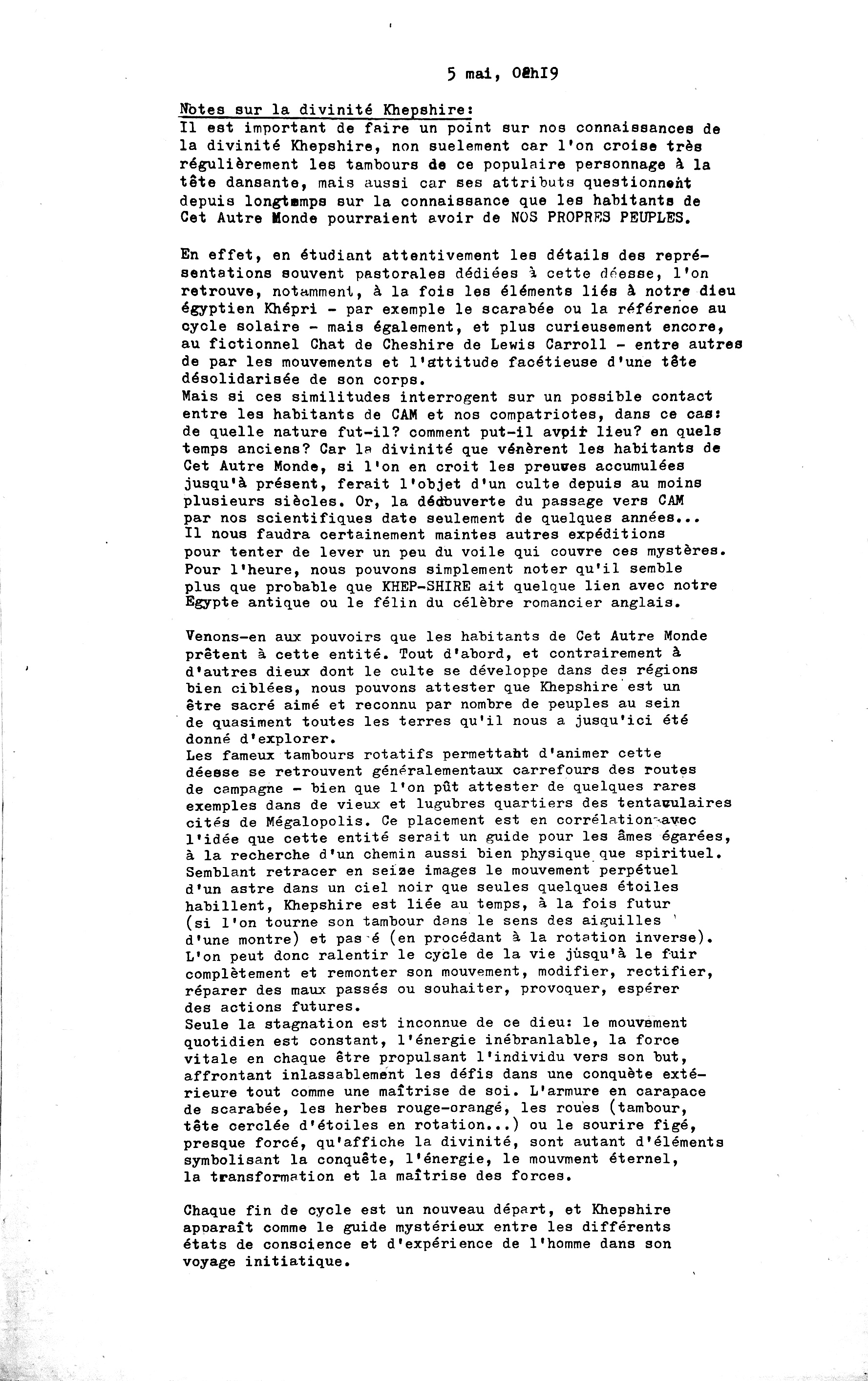
May 5, 02:19 a.m.
Notes on the divinity Khepshire:
It is important to take stock of our knowledge of the divinity KHEPSHIRE, not only because one so frequently encounters the drums of this popular figure with the dancing head, but also because its attributes have long raised questions about the knowledge that the inhabitants of This Other World might possess of OUR OWN PEOPLES.
Indeed, by carefully studying the details of the often pastoral representations dedicated to this goddess, one finds, in particular, elements linked both to our Egyptian god Khepri — for example the scarab or the reference to the solar cycle — and also, more curiously still, to the fictional Cheshire Cat of Lewis Carroll, notably through the movements and the mischievous attitude of a head detached from its body.
Yet if these similarities raise questions about a possible contact between the inhabitants of CAM and our compatriots, then what was its nature? How could it have taken place? In what distant times? For the divinity worshipped by the inhabitants of This Other World, if we are to believe the evidence accumulated thus far, has been the object of a cult for at least several centuries. And yet the discovery of the passage to CAM by our scientists dates back only a few years…
Many more expeditions will undoubtedly be required if we are to lift even a corner of the veil that shrouds these mysteries. For the time being, we can simply note that it seems more than likely that KHEP-SHIRE bears some connection either to our ancient Egypt or to the feline of the famous English novelist.
Let us now turn to the powers that the inhabitants of This Other World attribute to this entity.
First of all, and unlike other gods whose cults develop in very specific regions, we can attest that Khepshire is a sacred being loved and recognized by many peoples across nearly all the lands we have so far been able to explore.
The famous rotating drums that bring this goddess to life are generally found at crossroads along country roads, although a few rare examples have been identified in old, gloomy districts of the sprawling cities of Megalopolis. This placement correlates with the idea that this entity serves as a guide for lost souls, in search of a path that is both physical and spiritual.
Seemingly retracing in sixteen images the perpetual movement of a celestial body across a black sky adorned only by a few stars, Khepshire is linked to time—both the future (when one turns the drum clockwise) and the past (when rotating it in the opposite direction). One may thus slow the cycle of life to the point of fleeing it altogether and reverse its motion: to alter, correct, repair past ills, or to wish for, provoke, and hope for future actions.
Stagnation alone is unknown to this god: daily movement is constant, energy unshakable, the vital force within every being propelling the individual toward their goal, tirelessly confronting challenges in both an outward conquest and an inner mastery of the self. The scarab-shell armor, the red-orange grasses, the wheels (the drum, the star-ringed rotating head…), or the fixed, almost forced, smile worn by the divinity are all elements symbolizing conquest, energy, eternal motion, transformation, and the mastery of forces.
Each end of a cycle is a new beginning, and Khepshire appears as the mysterious guide between the different states of human consciousness and experience in mankind’s initiatory journey.
Notes on the divinity Khepshire:
It is important to take stock of our knowledge of the divinity KHEPSHIRE, not only because one so frequently encounters the drums of this popular figure with the dancing head, but also because its attributes have long raised questions about the knowledge that the inhabitants of This Other World might possess of OUR OWN PEOPLES.
Indeed, by carefully studying the details of the often pastoral representations dedicated to this goddess, one finds, in particular, elements linked both to our Egyptian god Khepri — for example the scarab or the reference to the solar cycle — and also, more curiously still, to the fictional Cheshire Cat of Lewis Carroll, notably through the movements and the mischievous attitude of a head detached from its body.
Yet if these similarities raise questions about a possible contact between the inhabitants of CAM and our compatriots, then what was its nature? How could it have taken place? In what distant times? For the divinity worshipped by the inhabitants of This Other World, if we are to believe the evidence accumulated thus far, has been the object of a cult for at least several centuries. And yet the discovery of the passage to CAM by our scientists dates back only a few years…
Many more expeditions will undoubtedly be required if we are to lift even a corner of the veil that shrouds these mysteries. For the time being, we can simply note that it seems more than likely that KHEP-SHIRE bears some connection either to our ancient Egypt or to the feline of the famous English novelist.
Let us now turn to the powers that the inhabitants of This Other World attribute to this entity.
First of all, and unlike other gods whose cults develop in very specific regions, we can attest that Khepshire is a sacred being loved and recognized by many peoples across nearly all the lands we have so far been able to explore.
The famous rotating drums that bring this goddess to life are generally found at crossroads along country roads, although a few rare examples have been identified in old, gloomy districts of the sprawling cities of Megalopolis. This placement correlates with the idea that this entity serves as a guide for lost souls, in search of a path that is both physical and spiritual.
Seemingly retracing in sixteen images the perpetual movement of a celestial body across a black sky adorned only by a few stars, Khepshire is linked to time—both the future (when one turns the drum clockwise) and the past (when rotating it in the opposite direction). One may thus slow the cycle of life to the point of fleeing it altogether and reverse its motion: to alter, correct, repair past ills, or to wish for, provoke, and hope for future actions.
Stagnation alone is unknown to this god: daily movement is constant, energy unshakable, the vital force within every being propelling the individual toward their goal, tirelessly confronting challenges in both an outward conquest and an inner mastery of the self. The scarab-shell armor, the red-orange grasses, the wheels (the drum, the star-ringed rotating head…), or the fixed, almost forced, smile worn by the divinity are all elements symbolizing conquest, energy, eternal motion, transformation, and the mastery of forces.
Each end of a cycle is a new beginning, and Khepshire appears as the mysterious guide between the different states of human consciousness and experience in mankind’s initiatory journey.